
History
The Faculty of Foreign Philology has deep historical roots; its history is inseparably linked with the history of the university itself.
Philology at our university dates back to the time of its foundation, namely to 1834, when the Pedagogical Institute was established on the basis of Kyiv University of St. Volodymyr. At that time, the Faculty of Philology was part of the Faculty of Philosophy; later, it was reorganised into the Faculty of History and Philology, whose academic staff provided the educational and instructional process in the newly established unit.
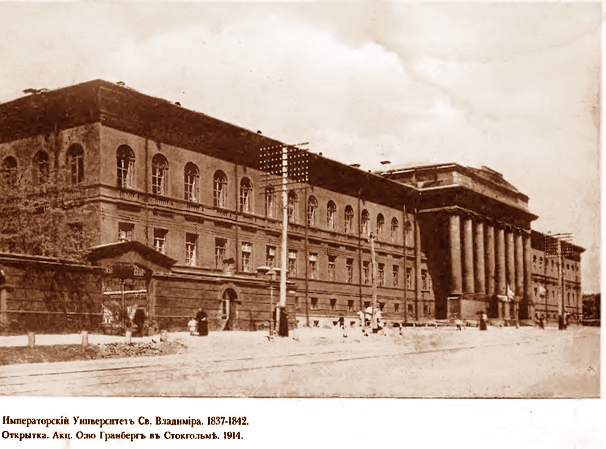
Kyiv University of St. Volodymyr, photograph from 1911
Almost simultaneously with the opening of Kyiv University of St. Volodymyr and its pedagogical division, the Department of Classical Philology – Greek and Roman literature – began its work. This was due to the fact that, in gymnasiums, that is, nineteenth-century secondary schools, classical languages – Ancient Greek and Latin – were compulsory throughout the entire period of study. Their study enabled young people to read in the original and translate the works of Homer, Xenophon, Ovid, Virgil, and Cicero. Latin and Ancient Greek were regarded as the foundation of a prestigious and high-quality education. Admission to the university was impossible without knowledge of these languages. European languages and literatures – German and French, and later English – were also compulsory subjects in universities and gymnasiums, as they were the languages of major scholarly publications and masterpieces of world literature at that time.
Throughout its existence, our faculty has had various names, structures, and subdivisions. The history of its development includes the following milestones:
1834–1850 – as part of the Faculty of Philosophy at Kyiv University of St. Volodymyr. On its basis, a “special educational institution”, the Pedagogical Institute, was established;
1850–1863 – as part of the Faculty of History and Philology at Kyiv University of St. Volodymyr and the Higher Pedagogical Courses at the university, which, from 1909, became the Teachers’ Institute;
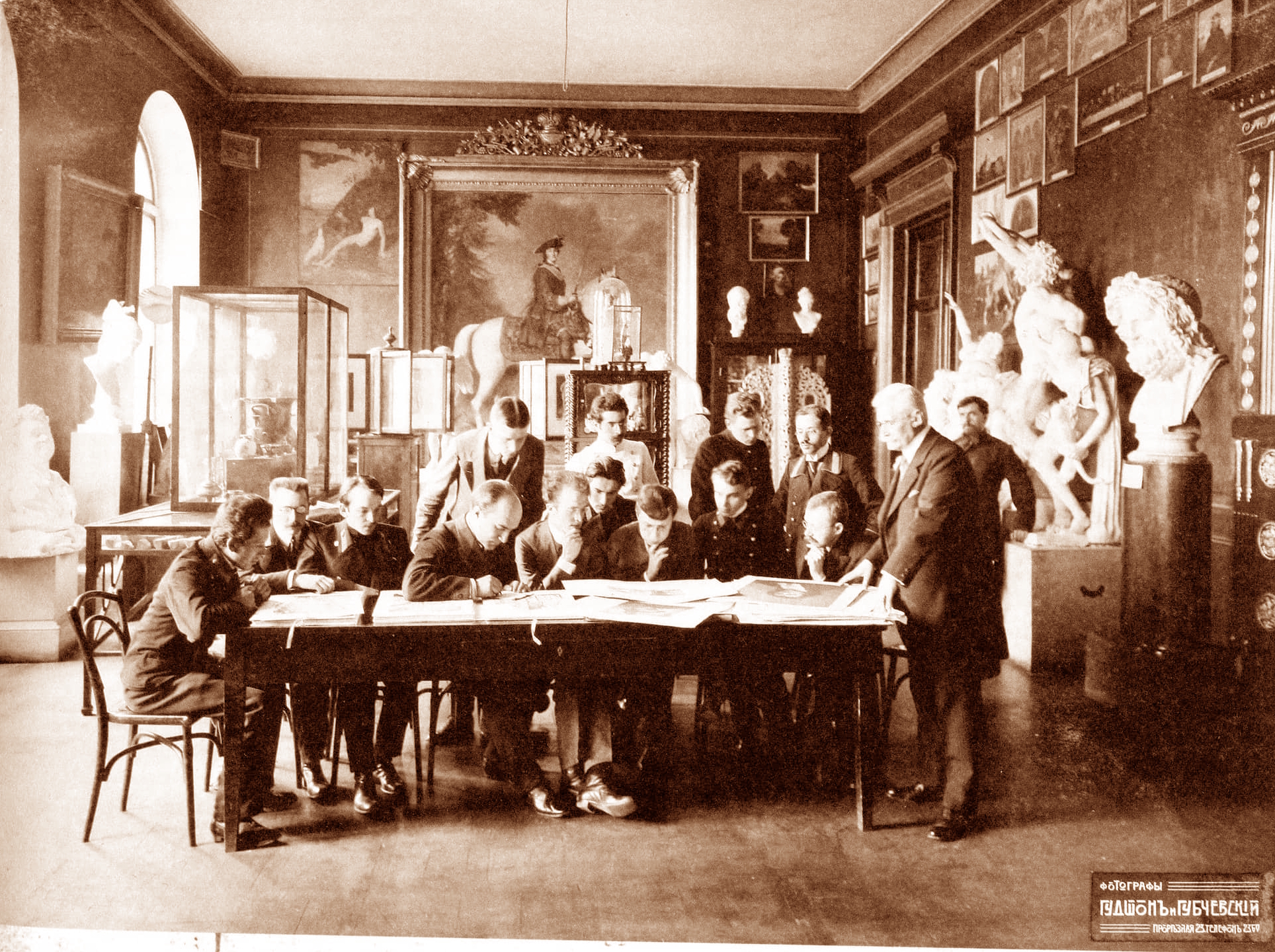
1920–1930 – as part of the Humanities Department of the Kyiv Institute of People’s Education named after M. P. Dragomanov. The institute was created as a result of the reform of higher education and incorporated such institutions as Kyiv University of St. Volodymyr, the Kyiv Higher Courses for Women, also known as St. Olga Women’s University, the Teachers’ Institute, and others;
1933–1945 – the Department of Language and Literature within the Kyiv Pedagogical Institute, which, from 1936, was named after O. M. Gorky;
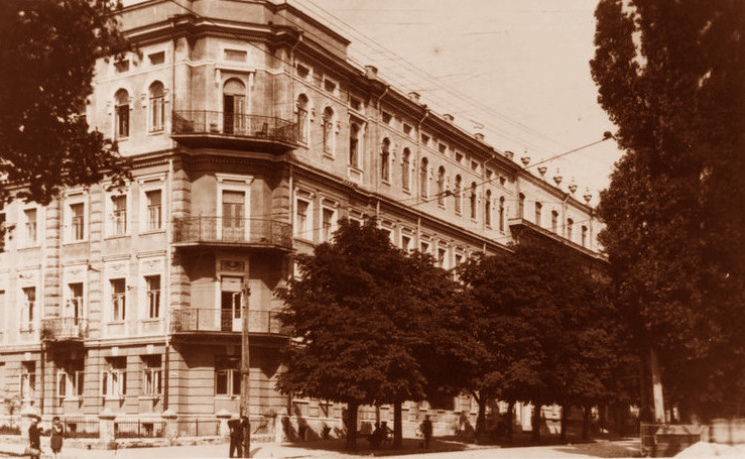
Photograph from 1935. Since 1934, the Kyiv Pedagogical Institute had been located in the building on Taras Shevchenko Boulevard (9 Pyrohova Street)
1945–1991 – the Faculty of Philology of Kyiv State Pedagogical University named after O. M. Gorky; in 1991, the university’s name in honour of M. P. Dragomanov was restored;
1993–1997 – the Faculty of Philology of the Ukrainian State Pedagogical University named after M. P. Dragomanov;
1997–2005 – the Faculty of Foreign Philology of the National Pedagogical University named after M. P. Dragomanov;
2005–2015 – the Institute of Foreign Philology of the National Pedagogical University named after M. P. Dragomanov;
2015–2022 – the Faculty of Foreign Philology of the National Pedagogical University named after M. P. Dragomanov;
01.12.2022 – present – the Faculty of Foreign Philology of Mykhailo Dragomanov Ukrainian State University.
After Ukraine gained independence, the Faculty of Foreign Philology was headed by:
Volodymyr Ivanovych Honcharov, Doctor of Philosophical Sciences, Professor – the first Dean of the Faculty of Foreign Philology and Director of the Institute of Foreign Philology from 1986 to 2015. During his tenure, the range of foreign languages and specialities was significantly expanded, with Spanish, Italian, Polish, Turkish, and Chinese being introduced. Programmes for the language training of international students were implemented; the educational and material infrastructure was developed, including the establishment of the Centre for Language and Literary Education and the Turkish Cultural Centre. Cooperation with the British Council, America House, the French Cultural Centre, the Goethe-Institut, and the embassies of Japan and Poland in Ukraine was strengthened, enabling students and academic staff to participate in international programmes, including the Fulbright Program, grants, the I.T.A.C.A. Summer University in Segesta, Italy, and other initiatives.
Alla Anatoliivna Zernetska, Doctor of Philological Sciences, Professor – Dean from 2015 to 2023. During her tenure, the faculty’s traditions, research activities, and international cooperation continued to develop. The Centre for Collective Use of Scientific Equipment “Digital Technologies in the Humanities”, the Research, Educational and Production Centre for Linguistic Text Analysis and Translation, and the Research, Educational and Production Laboratory of Applied and Corpus Linguistics were established.
Since July 2023, the Faculty of Foreign Philology has been headed by Nataliya Yevhenivna Lemish, Doctor of Philological Sciences, Professor.
At various times, the faculty has been home to distinguished scholars of philology, including:
- Academician of the National Academy of Sciences of Ukraine Dmytro Serhiiovych Nalyvaiko,
- Academicians of the National Academy of Educational Sciences of Ukraine Liubov Ivanivna Matsko and Petro Panasovych Khropko,
- Doctors of Philological Sciences, Professors Mykhailo Yakymovych Brytsyn, Arnold Panasovych Hryshchenko, Ivan Trokhymovych Kruk, Mykola Mykolaiovych Pylynskyi, Volodymyr Fedorovych Pohrebennyk, Nina Tykhonivna Pronina, Halyna Volodymyrivna Sodol, Borys Borysovych Shalahinov, and others.
The faculty has also been associated with well-known scholars in the field of methodology, including Doctors of Pedagogical Sciences, Professors Tetiana Fedorivna Buhaiko, Alla Yosypivna Kapska, Lesia Fedorivna Miroshnychenko, Yevhen Andriiovych Pasichnyk, and others.
Today, the academic staff of the Faculty of Foreign Philology honour the traditions that have developed within the faculty and make every effort to ensure the further advancement of the faculty and the university, as well as their confident progress into the future.